
By Samuel Bagenstos1, Seth Frotman2, Amy Marshak3 & Karl Thompson4
Executive Summary
An agency general counsel (GC) plays a unique role. As the chief legal officers and primary legal advisors for federal departments or agencies, GCs are typically involved in all of the agency’s highest-priority actions, and they are one of the few high-ranking officials who see the entire universe of actions across an agency. For lawyers looking to make an impact on whether and how government delivers on its promises, the GC role is perhaps unmatched across the organizational charts of government agencies.
General counsels’ offices (OGCs) vary in size and function across agencies. Among other responsibilities, a general counsel’s office generally advises on the interpretation of the Constitution and the statutes and regulations their agency administers, as well as on employment, contracting, grants, ethics, and other operational issues; manages agency responses to oversight requests, including congressional inquiries; and often coordinates with the Department of Justice (DOJ) to represent or defend the agency in administrative hearings and lawsuits in federal courts. Interviews with former government officials indicate that while general counsels do many things well, GCs (and the OGC teams they oversee) do not always take full advantage of the ways they can, as legal advisors, act as strategic partners to agency leadership and other agency components to advance the agency’s mission and the broader administration’s priorities.
The general counsel as advisor
GCs who are oriented toward helping their agencies achieve their objectives can be transformative for the federal government’s ability to serve the American people. It is of course part of a GC’s job to tell agency leadership when a proposed course of action would be unlawful, though it is rare in most well-run agencies for leaders to insist on an action that cannot be accomplished legally. More often, a general counsel’s function is to help agency leadership achieve its goals in a lawful fashion. That function requires a rich understanding of the agency’s goals, knowledge of and judgment about the legal and legal-adjacent risks of various pathways for achieving those goals, and robust two-way communication about the best course of action in light of the relevant risks and benefits. OGC attorneys are particularly well positioned to identify which of the agency’s various legal tools, including previously unused or underused statutory authorities, can be brought to bear to solve the real-world problems the agency is tasked with addressing. And, if engaged early in a decision-making process, GCs and OGC lawyers can work with agency counterparts to use their expertise to strengthen the agency’s policy objectives and their implementation against legal challenges, making such actions more sustainable and effective in the long run.
A key part of a GC’s advising role is assessing the risks that an agency’s proposed actions may pose. Specific and precise risk assessments can make it easier for decision-makers to understand the legal risks a course of action may present and weigh those risks with other considerations, including the risks to the agency’s mission presented by inaction or less ambitious action. General counsels must be as clear as possible in communicating the types of risk at issue, the ways they may materialize, their best assessment of the likelihood that they will occur, how harmful they may be if they do, and the uncertainties inherent in all these estimates. Types of risk the GC should consider include litigation risk—the risk that agency action may be challenged in court; oversight risk—the risk that agency action may provoke burdensome oversight by Congress, watchdog agencies, or even the press; and precedential risk—the risk that taking some action today may restrict an agency’s or the broader government’s options to act in the future.
Working with the team
It is not enough if the GC alone takes a proactive approach to advising agency counterparts. At every agency, career staff make up the bulk of OGC and do most of its work, and there is simply no way for the general counsel, or their OGC leadership team, to see all of the advice the office is providing at any given moment. General counsels must rely on, and actively manage, their career staff, so that OGC as a whole can be aligned on how to approach their advising responsibilities and best support the agency in meeting its mission and serving the public. For example, GCs should find ways to enlist their most talented and expert career staff to serve as thoughtful partners in enabling the agency to vigorously and lawfully carry out agency priorities. GCs also should create a culture where the candid advice of career attorneys is solicited, heard, and taken seriously; but they need to be prepared to challenge their staff’s advice when it is not aligned with the principal’s risk tolerance or is more conservative than the relevant legal constraints demand. Finally, general counsels should build structures and processes within OGC that reduce bottlenecks, elevate decisions as necessary, and align OGC resources and staff time to best support the agency’s mission.
Outside of OGC, a general counsel can facilitate an agency’s ability to achieve its mission by routing decisions to the appropriate decision-makers, resolving conflicts among agency components and between agencies, and keeping priorities on track. To play this facilitative role, the GC must build strong relationships of trust and maintain open lines of communication not just with their agency principal and other agency components, but also with the Department of Justice, the White House, the Office of Management and Budget, and other executive branch agencies that share an interest in the actions the agency is taking.
In short, the job of an agency general counsel is challenging and multifaceted. When undertaken thoughtfully and with purpose, it can have a powerful impact on an agency’s ability to deliver for the American people.
Our Methodology
This best practices guide is drawn from the authors’ experience working as and with agency general counsels, and from more than two dozen interviews and discussions with former general counsels, deputy general counsels, career attorneys in general counsel’s offices, and agency and White House leaders who worked closely with general counsels. Interviewees served across the federal government in traditional executive branch agencies, independent agencies, and White House policy offices. The authors also consulted prior writings by and about agency general counsels.
Introduction
The job of the agency general counsel
An agency general counsel plays a unique role. As the chief legal officer and primary legal advisor for a federal department or agency, the GC directly shapes how an administration executes its agenda while ensuring compliance with law. Because nearly all matters of significance require some degree of legal review, GCs are typically involved in all of their agencies’ highest-priority actions—including major policy initiatives, the operational decisions necessary to implement agency priorities, and litigation defending agency actions—and they are one of the few high-ranking officials who see the entire universe of actions across an agency.
General counsels’ offices (OGCs) vary in size and function, from large bureaucracies within cabinet-level departments that house a network of specialized legal divisions, to teams of a few dozen attorneys that include experts on critical but niche questions of federal law, to nationwide teams of attorneys who drive an affirmative enforcement agenda for a regulatory agency. The responsibilities of general counsels vary agency by agency, but can include:
- Advising on the interpretation of the Constitution and the statutes and regulations that an agency administers;
- Overseeing the drafting, review, and promulgation of agency regulations, administrative procedures, and official policy guidance;
- Leading an agency’s enforcement and affirmative and defensive litigation efforts;
- Coordinating with the Department of Justice to represent or defend the agency in administrative hearings and lawsuits in federal courts, including appeals;
- Advising on employment, contracting, grants, data management, ethics, and other operational issues;
- Managing agency oversight, including congressional inquiries; and
- Supervising teams of mostly career attorneys to meet these responsibilities.
All of these functions support an agency’s ability to achieve its mission and serve the public in ways that are consistent with the law.
Interviews with former government officials revealed that many leaders perceive that agency GCs do many aspects of their job very well. But it can be difficult for even excellent lawyers to reorient their thinking from seeking the best legal answer or minimizing a client’s legal risk to factoring in the opportunity cost of inaction and providing meaningful advice on lawful but riskier options. Our research has indicated that this function—identifying ways to lawfully achieve an agency’s objectives and advising on the risks and benefits of potential actions in light of legal uncertainy—is where OGC attorneys have been perceived as a bottleneck or an obstacle to agency action, and therefore where guidance will be most useful for future general counsels. This is true whether the legal questions at issue pertain to an agency’s decision to issue a regulation to address a particular problem, how and with whom the agency may share data, and everything in between.
This best practices guide therefore focuses on (1) how a general counsel should approach advising agency leaders and staff about strategic pathways and legal risks as they work to further the agency’s mission, and (2) the GC’s responsibilities for managing their OGC team, agency leadership, and other agencies and White House staff as part of that advisory process. This guide begins by exploring the ways in which OGC attorneys have been perceived as an obstacle to effective agency action before turning to an exploration of principles for how GCs can successfully operate as problem-solving partners within federal agencies and across the executive branch.
The Problem: How OGC Advice Fails
General counsels’ offices sometimes have a reputation for being the “office of no”—a hive of undue risk aversion where policy ideas are delayed, watered down, or killed. This reputation can take hold even when general counsels do not understand themselves to be saying “no” and are not seeking to obstruct their agency’s efforts to take vigorous action.
How general counsels and OGC attorneys understand the task before them may be a factor in this disconnect. If the general counsel understands their job as identifying—and protecting the agency from—legal risk, rather than lawfully advancing the agency’s and administration’s goals, they are likely to err on the side of conservatism and inaction in their advice. This is all the more true if they fear that they will be blamed when risks do come about. The prospect of a loss in court, an adverse Government Accountability Office (GAO) finding, or a well-publicized oversight hearing can loom large for lawyers advising on agency action, but the downsides of failing to take a particular action are often much more diffuse, and far less apt to result in blame.
This conservative bias can manifest itself in different ways: OGC attorneys may perceive their job as identifying every possible legal risk, without assessing how likely or how harmful those risks might be. Or they may see their role as identifying the “correct” interpretation of a statute or regulation (even when courts have not identified any such answer), and thus treat any other interpretation, even ones on which reasonable minds could disagree, as wrong. Or OGC attorneys may engage with agency staff in multiple rounds of discussion, wordsmithing, and revision in a quest to reduce risk without driving toward a decision point—all the while losing sight of the ultimate goal of the document on which they are advising.
The way lawyers deliver their risk advice may also lead their clients to hear a “no” that the lawyers do not intend to communicate. The advice given by a general counsel or OGC staff attorney may be too vague to be actionable. An attorney may flag that an action “poses risk” without usefully describing the likelihood that the risk will materialize or the harm to the agency if it does. When faced with such generic flags, agency leaders or policy officials may not know how to respond or how to weigh the idea of “some risk” against other factors. They may see the flag as communicating that OGC believes the agency should not undertake the action, even if that is not what the attorney who identified the risk intended to convey.
Finally, a distinct problem occurs when legal advice or a legal assessment comes too late in the process—when a proposed action has already crystallized and is very close to public announcement. As discussed below, when OGC lawyers are engaged in considering and formulating options early in a decision-making process, they can help shape the alternatives in ways that achieve the leaders’ goals without heightened legal risk. But when OGC review occurs toward the end of the process, it may be too late to implement any OGC-generated alternatives on the timeline decision-makers previously agreed to meet. Agency leaders thus feel trapped into go/no-go decisions with two bad choices, and agency lawyers feel like they’ve been given an impossible task. Situations like these breed distrust among agency staff and OGC lawyers and can lead staff to seek to exclude OGC attorneys from future decision-making processes, perpetuating a problematic cycle.
General counsels must be embedded in the policymaking process early. If there is trust that legal won’t just shout ‘no,’ policy teams will bring lawyers in early. If there is no trust, policy teams will hide initiatives from lawyers until the last minute.
– Former OGC Attorney
At the same time, it is worth noting that the “office of no” characterization can be an oversimplification. In some circumstances, agency leadership and other agency staff who do not want to pursue a particular plan may misleadingly claim that attorneys have vetoed an action in an effort to mask a policy disagreement as a legal prohibition. Other times, agency staff, fearing a “no” even before any advice is given, may seek to exclude OGC from the decision-making process altogether so that the ultimate decision-maker will not be swayed against their preferred approach, which may lead to a late-stage intervention by OGC that emphasizes the risks of the proposed action.
Nonetheless, our research indicates that the problems described above do happen and affect the relationship between OGCs and their agency counterparts. Each of these failings is understandable in the institutional contexts in which GCs operate, but the costs can be significant to the government’s ability to act effectively—and, ultimately, to the public’s trust that the government can solve important problems. A general counsel who understands these dynamics, effectively manages their own office, and acts as a strategic partner to agency leadership can overcome many of these issues. It is to those objectives that we now turn.
The Premise: Pathways, No Permission Slips
GCs who are oriented toward helping their agencies achieve their objectives via lawful pathways can be transformative for the federal government’s ability to serve the American people. When the general counsel and the OGC team alike approach their counselor role as problem-solving partners, they can help identify novel and effective approaches to problems and strengthen agency action against legal challenges, making such actions more sustainable and impactful in the long run.
To be effective, general counsels must understand their role. The general counsel is ultimately a facilitative position. It is of course an essential part of a GC’s job to tell agency leadership when a proposed course of action would be unlawful. This may be especially important in agencies where the government deploys physical force, where its actions are unlikely to raise justiciable issues, or both. But in most well-run agencies, it is rare for agency leaders to insist on an action that simply cannot be accomplished lawfully. A general counsel’s function is thus more often to help agency leadership achieve its goals in a lawful fashion. To be clear, that does not require the GC to push for the most conservative legal path in each and every instance. Rather, that function requires a comprehensive understanding of the agency’s goals, knowledge of and judgment about the legal and related risks of various pathways for achieving those goals, and robust two-way communication about the best course of action in light of the relevant risks. It also requires the GC to have a deep knowledge of the agency’s authorities, the energy to stay abreast of the evolving context in which the agency acts, disciplined creativity in applying legal authorities to facts, a firm grasp of the policy issues and political context that may enable or constrain the agency, and a strong desire to ask questions and learn from subject matter experts across the agency, the wider government, and the public.
Instead of being reactive, great general counsels proactively canvas existing law to find creative ways to achieve the president’s goals without needing new legislation.
– Former White House Official
The best general counsels are proactive. By understanding agency leadership’s goals, GCs and OGC attorneys can serve as affirmative thought partners to their agency counterparts, who can range from cabinet-level secretaries, agency leaders, and White House officials to decision-makers within agencies in policy, programmatic, or operational offices. General counsels can be among the best-suited agency officials to understand how the agency’s various legal tools and authorities can be employed to advance the mission and solve the real-world problems the agency is tasked to address. GCs and their teams can identify unused authorities, dust off rarely used ones, or creatively recast statutes and regulations to solve legal questions and advance policies in support of the agency’s and administration’s mission.
To best advance the priorities of their agency and the administration they serve, agency general counsels need to be thoughtful about how they use their and their teams’ limited time and resources. We offer here a few suggestions about how a GC may achieve this goal.
Focus on agency priorities
An effective GC must understand how to focus their own time and energy where it will produce results for the agency’s priorities. Incoming work can fill every hour of a general counsel’s day, and determining what is important for the GC to personally spend time on can determine whether the GC is able to advance the agency’s work or merely keep up with the flow of paper. This also extends to the time of OGC staff attorneys. Although we discuss managing OGC staff at length in a later section, it is important to note at the outset that, as the manager of a legal bureaucracy, an agency general counsel has the ability to influence the priorities and resource allocation decisions of the OGC team. In the face of limited resources, GCs can play a powerful role in helping their team prioritize what needs to be done (and how it should be done) so that OGC attorneys can participate more fully in high-impact agency efforts.
An effective general counsel should also understand which agency tools are particularly within their control and take the lead in harnessing those tools to achieve agency priorities. For example, to the extent that an agency has an affirmative litigation or enforcement agenda, the GC can play a particularly important role in setting and managing litigation priorities. Or a general counsel with a significant role in rulemaking can ensure that priority regulations are prioritized and moved expeditiously through the rulemaking process.
Get involved in decision-making processes early
The general counsel and their team can most effectively contribute to the success of their agency’s mission if they are involved in decision-making processes from the very beginning. At that point, the general counsel can help develop legal options for achieving policy goals, identify the legal (and legal-adjacent) risks and benefits of those options, and describe alternative paths and their trade-offs. Attorneys become active partners in developing policy, rather than being placed in the untenable position of reviewing something at the last minute and identifying major problems it may be too late to address.
Not all agency staff will think to (or even think they want to) include the general counsel’s office from the early stages of a new decision-making process, and an important part of the GC’s job is to ensure that this happens anyway. An effective general counsel can create trust with agency staff by building strong relationships outside the context of any particular issue, establishing open lines of communication, and showing through their work that they are committed to achieving the agency’s mission. By building this trust, the GC will be more likely to be made aware of policy initiatives and can therefore intervene sooner, when their input can be most valuable.
In the best policy processes, the GC’s office is embedded in a constant loop of conversations with policy staff about which paths were legally compelling, and the political and strategic choices those decisions entailed. The policy team would then feed the legal pros and cons into the discussion with the other dimensions of the policy process (political, budget, etc.) so that all aspects of the problem could be considered.
– Former White House Official
Embed OGC attorneys on interdisciplinary teams
One useful approach to early engagement on significant agency initiatives that is employed by many offices is to create cross-functional law and policy teams that work together as partners in developing, implementing, and preparing to defend key policies. These teams can bring together, as needed, agency policy staff, OGC lawyers, DOJ litigators who will be charged with defending the program in court, communications staff, legislative affairs staff, and staff from other relevant disciplines. Ideally, OGC lawyers working in these teams will, at the outset of discussions, be able to present creative ideas for using agency authorities to achieve the policy goal—ideas that even the policy team may not have come up with. The lawyers can also discuss with policymakers and communications teams how to talk about their decisions in ways that manage legal risk, thus helping to avoid what seem like nitpicky linguistic edits that in fact make a big difference when it comes to later legal and oversight challenges.
Push back when necessary
Unlike other political leaders, the GC is focused on whether the agency may lawfully take the action it wants to take, and GCs must sometimes tell their clients what they would rather not hear. Even beyond the rare situation where there is no professionally responsible argument for the legality of a proposed course of action, some tension between agency leaders and their lawyers is inevitable—and can be a sign of a healthy attorney-client relationship and a rigorous process that helps get to a stronger, more legally sound path forward. In providing that advice and communicating about legal risks, the GC should apply the principles we discuss in the following section.
Communicating Risk
A key part of the GC’s role as a strategic partner is to assess and communicate the risks that the available pathways to agency actions may pose. Whether a particular action is lawful is rarely a yes or no question—the laws that shape agency actions are likely to be open to interpretation in any particular context. In most cases, the crucial questions are going to be questions of risk: What bad things might happen if the agency pursues its proposed course of action? How likely is it that they will happen and how bad would those things be? And are there ways of achieving (all, nearly all, or some of) the agency’s goals while mitigating those risks?
When there is a range of possible legal interpretations, it is not the general counsel’s job to insist that the agency follow their own understanding of which legal view is “best” in some abstract sense (though of course they should share that understanding with the client if asked). An effective general counsel should not frame risk as certainty, or suggest that their view of the “best” interpretation should control government policy. Instead, a GC should make sure the agency client understands the most accurate possible prediction of the nature and extent of the risk, as well as the costs and benefits of ways to mitigate the risk, so that the client can make an eyes-open decision about whether the risk is worth running to achieve some agency goal.
Varieties of risk
When agency leadership proposes a particular course of action, the general counsel will sometimes confront a real question about legal authority—whether there is a professionally responsible argument that the law authorizes the action agency leaders have proposed. As noted above, though, it is the rare case in which a general counsel can say an agency wholly lacks authority to engage in a proposed course of action. When agency leadership does propose an utterly unauthorized action, it is the job of the GC to make the lack of authorization clear to agency leaders—and their White House superiors as necessary—and work with leadership to find a lawful means of achieving as much of their legitimate objective as is feasible.
You’re not asking for just the ‘right’ legal answer; you’re asking for good faith legal arguments for the available options in order to address the pros and cons of each option.
– Former OGC Attorney
Much more often, though, general counsels confront issues of legal risk. The issues come in several varieties, and we highlight a few key types here:
- Even if there is a professionally responsible argument for a proposed course of action, leaders will want to know whether someone is likely to sue and what consequences will follow if a suit is filed. For policy initiatives, leaders will want to know if the action is likely to be delayed or invalidated in court. For other agency actions, they may want to know if litigation over a proposed action could subject government officials to personal liability or other consequences. All these are forms of litigation risk.5
- Leaders will want to know whether an action is likely to subject the agency to burdensome and intrusive oversight—from congressional committees, watchdog agencies like GAO or an inspector general (IG), or even the press—and what the likely impacts of that oversight will be (e.g., diverting agency resources, budget cuts, potential reputational harm, administrative consequences). That is oversight risk. Oversight risk often overlaps with more general political risks attendant to a proposed course of action, and general counsels should be prepared to advise on those broader risks as well. But they should be especially clear that decisions on political risk are for the client to make.
- Leaders will want to know whether implementing the proposed course of action today will limit agency options in the future, through mechanisms of path dependence that legally or practically lock the agency into that proposed course of action for a long time to come. Leaders will also want to know if a detrimental court opinion could impact the agency’s, or the government’s, ability to pursue a broader ambit of initiatives or priorities, not just the immediate agency action at issue. Those are forms of precedential risk.
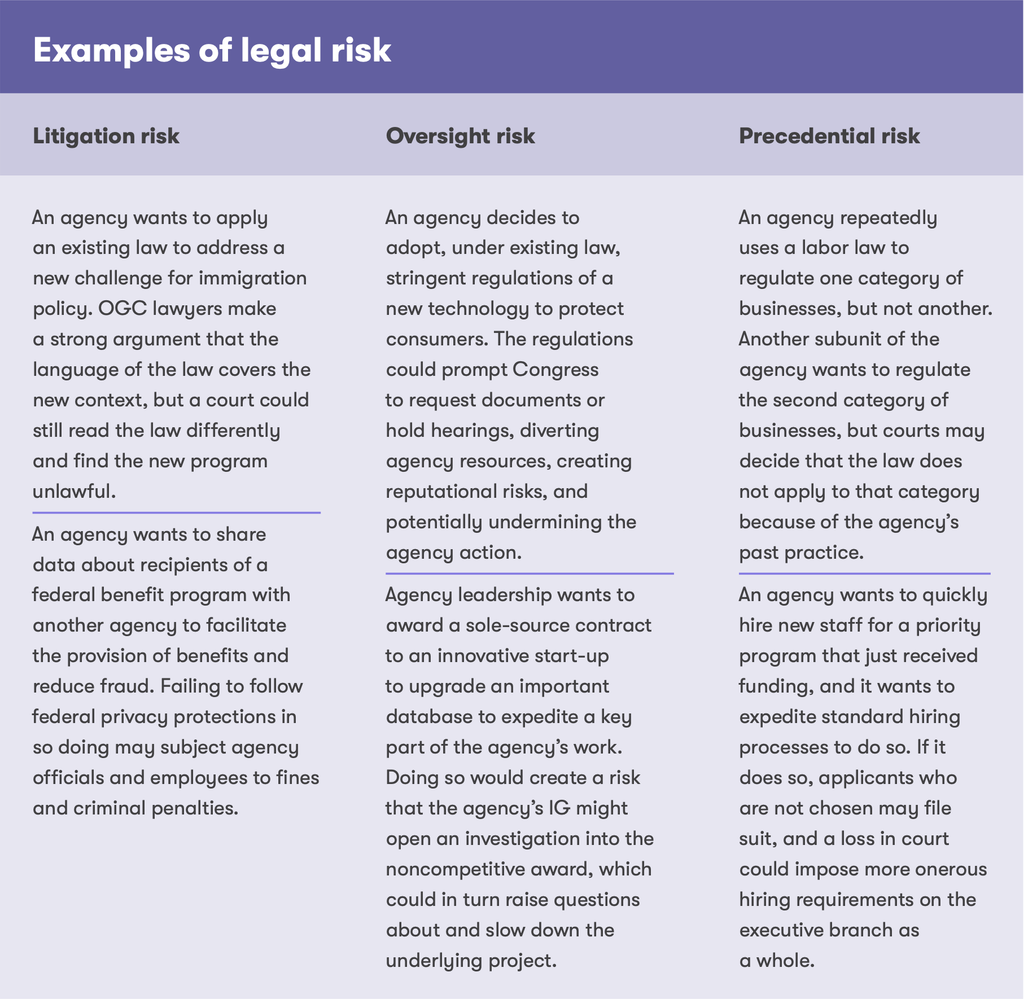
Litigation risk is the most obviously “legal” of these forms of risk. Virtually everyone involved in major agency decisions understands that the general counsel (perhaps in consultation with the Department of Justice) will advise on the litigation risk of a proposed action. The other two forms of risk incorporate political and policy concerns as well as legal questions. Assessing oversight risk requires understanding what sorts of criticisms are likely to resonate politically. And assessing precedential risk requires understanding what sorts of actions agency leaders might wish to take in the future to advance their policy goals and what sorts of actions future administrations might take using the same legal arguments. (Because one administration’s refusal to adopt a broad interpretation of its power cannot reliably prevent a future administration from doing so, though, general counsels should not overemphasize the latter point.)
A legal lens on oversight and precedential risk questions is also crucial. Oversight efforts are often framed in legal terms—as seeking to uncover violations of law, or as highlighting the need for legal changes. The mechanisms of oversight are often regulated and constrained by law (including the limits on congressional, GAO, or IG investigative authority, the balancing of legislative and executive interests, and the scope of executive privilege). And legal rules are often the reason precedential risk exists: If an agency applies a broad statutory or constitutional authority one way today, a court might find future applications of that authority to be arbitrary and capricious if they differ too much from, or rest on different factual or legal premises from, today’s action. Agency leaders thus cannot understand the full extent of oversight and precedential risk without well-informed legal advice. Conversely, general counsels cannot provide good advice without a solid understanding of the political and policy context in which they are working.
This is not an exhaustive list of conceptions of “risk.” There are of course other risks and benefits that agency policymakers must also weigh when selecting a course of action, and a GC acting as a strategic partner can help agency leaders assess those risks. Moreover, a decision not to act, to delay, or to take an approach that achieves fewer of the agency’s priorities presents its own form of risk: delay and forgone alternatives are themselves costly. This discussion is merely meant to highlight various aspects of legal risk that should inform a general counsel’s risk assessment as part of an agency decision-making process.
Framing the risk assessment
General counsels must be as clear as possible in communicating their legal analysis. For any particular proposed path forward, GCs should address the types of risk at issue, the ways they might come about, and their best assessment of the likelihood that they will occur. And they must be clear in communicating the uncertainties inherent in their estimates.
What to communicate
Ideally, every risk assessment should answer seven sets of questions:
- Is the agency action likely to be challenged, and if so where? In court (and, if so, in a particularly hostile court)? Is a court challenge likely to get the attention of oversight bodies? If so, how will that likely play out (IG investigation, congressional investigation, etc.)?
- Where litigation risk is involved, what aspects of the agency’s action are likely to be challenged and why? How is each challenge likely to be resolved? Is the agency likely to prevail on procedural grounds? On the merits? Or neither? (The analysis should address parallel questions when oversight risk is involved.)
- How much is the agency, or the government more broadly, likely to be constrained if the litigation, oversight, or precedential risks materialize?
- How confident is OGC in these assessments, and what would change the estimates?
- If the risks come about, what are the opportunity costs of the time the agency will have taken to craft and defend the action? What might be the costs to the agency’s operations and the people who depend on the agency if its action is unwound? What trade-offs is the agency accepting by taking this action?
- How can the agency mitigate the identified risks while achieving its goals—and what less risky alternatives might OGC propose that do not achieve the agency’s goals fully, but might do so to a significant extent? (In proposing any such alternatives, OGC should be open about the policy trade-offs involved.)
- And if the agency fails to act—or if it delays action while developing alternatives—what will be the cost to the agency’s goals?
Agency attorneys should approach these questions with humility, and their advice should reflect the full scope of uncertainty regarding the answers in a fast-changing legal environment, as well as any factual uncertainties as the decision-making process unfolds.
Breaking up the risk advice into its component parts in this way enables the principal to make good, well-informed decisions. It also plays a disciplining role for general counsels and their staff by encouraging careful assessment of the nature and extent of the risk, and of the uncertainties inherent in that assessment, rather than a reflexive response. The point should emphatically not be to paper the file so that the general counsel can deflect responsibility for a bad outcome later—that sort of conduct only erodes trust between lawyers and clients, making it difficult for the GC’s office to do its job. The point should be to ensure that agency leadership has what it needs to make an eyes-open choice about a course of action.
How to communicate
There are many ways to communicate the extent of a risk. Many clients will ask for a numerical estimate (e.g., “This policy is 75 percent likely to be struck down”). Attorneys typically (and understandably) balk at providing numbers, which are likely to convey an unwarranted degree of precision, especially given the conditional nature of the estimate.
In determining how best to communicate the nature and extent of risks, general counsels should consider past practice within OGC (including any pitfalls of that past practice), and how agency clients most effectively receive such information, in order to develop a system that works for their agency. The key is that risk advice must be usable: Attorneys must unpack the basis for the risk assessment (using the component parts discussed above) and candidly communicate the attorney’s degree of confidence in that assessment.
In developing their approach, general counsels should be wary about relying too much on ambiguous adjectives such as significant, serious, or substantial. Those adjectives convey some information—a serious risk is more worrisome than a trivial risk—and can be combined with analysis that illuminates what the adjective is meant to convey. But such adjectives can nonetheless be difficult to interpret, especially for agency staff who do not have a vantage point that allows them to compare across risk assessments.
An OGC lawyer shouldn’t insist that their reading is the only reading when it’s actually a 70–30 question. A 70–30 question requires presenting both options to the principal so the principal can choose their desired level of aggressiveness.
– Former OGC Attorney
General counsels could consider developing a practice of providing risk predictions in numerical bands (e.g., “We have a 30 to 50 percent chance of losing in court”). Attorneys can often develop comfort in providing an assessment phrased as a range, and clients may find that information easier to digest than an adjective, even when the adjective is combined with an explanatory analysis. At the same time, a numerical band approach may be difficult when it relies on multiple contingencies or factual questions that affect the confidence level of the estimate.
In making risk assessments, OGC attorneys should keep the following points in mind:
Likelihood is not confidence
Every estimate of how likely it is that a risk will materialize should carry a separate confidence label: high, moderate, or low, plus a sentence on what would change the estimate. The client will want to know the attorney’s best assessment of the risk. But the client will also want to know how good the attorney thinks that assessment is. Agency leaders will trust the general counsel’s office more if they are honest and open about uncertainties and do not overstate their degree of confidence.
In order to maximize the confidence of their assessments, general counsels and OGC career attorneys should remain in close communication with their counterparts in policy and program positions throughout the agency, who have a more granular understanding of how a proposed policy will work and whom it will affect in various circumstances. Working from facts, rather than assumptions about how a program operates or the objectives it seeks to achieve, is critical to both the accuracy of the general counsel’s assessment and to maintaining the trust of policy and program staff.
In some cases, a general counsel may need to engage in additional, more time-consuming fact gathering or other action in order to make a more confident assessment of the risks involved before the client makes a decision. In this case, an agency head may want to put the proposal on a brief pause to enable the GC to do so. That will of course depend on the cost of delay to the agency’s goals. When agency action aims to respond to an urgent problem, uncertainty in the risk estimate is likely to be a tolerable cost of acting to meet the problem. Even in the absence of immediate urgency, delay can be costly, if only because any administration has only a limited time in office.
Litigation risk is a chain, not just a number
Litigation risk has conditional structure: the probability that someone sues (and that the challenger secures an adverse forum), that the challenge survives procedural defenses, that the government then loses on the merits, and that a merits loss constrains future action by the agency—all of these are separate predictions. When conveying litigation risk, general counsels must be careful to communicate that conditional structure. If it is unlikely that any party will be found to have standing to challenge a proposed action, but the agency is overwhelmingly likely to lose on the merits if a plaintiff is held to have standing, the GC should make both halves of that assessment clear. The general counsel should not simply say that the risk of a loss is overwhelming, nor should the GC obscure those separate assessments by communicating merely that there is “some risk” overall.
Severity is as important as likelihood
The general counsel does not merely advise about how likely it is that a risk will materialize. The GC also advises about how bad it will be if it does. For certain decisions, especially those affecting government operations, agency leaders and staff can face consequences as severe as personal (or even, in some cases, criminal) liability. The severity of the harm can also be measured by the scope of the constraint it places on governing choices:
- The constraint may be action-specific. It may, for example, require the agency to institute new proceedings to implement a desired action. This could be the case in the context of a rulemaking under the Administrative Procedure Act, where, for example, a litigant succeeds only because the agency failed to satisfy all the requirements of the notice and comment process. Or it could be the case in the context of a bid protest about a particular contracting decision. The costs in these cases are essentially opportunity costs—the time and energy spent on taking action in the first place, as well as the time and energy of going back and trying again, both of which necessarily detract from other agency priorities.
- Agency-specific constraints might impose broader costs by preventing the agency from taking a proposed action, or anything like it, again (e.g., if a challenge succeeds on grounds relating to the agency’s substantive authority). The constraint may extend even more broadly from a particular policy to a larger program (if, for example, a court gives a narrow reading to a statute that is relied on by other policies under that program), or the entire agency (if, for example, a court gives a narrow reading to a statute or an operational authority often relied upon by the agency across programs).
- Constraints can even extend as far as the entire government if, for example, a court imposes new constitutional limitations or expands trans-substantive deregulatory principles like the major questions doctrine.
- Sometimes, as can occur with precedential risk, the constraint may arise because the challenged action is upheld in court—the agency may be constrained from adopting a different desired policy in the future, or another subagency may be constrained from adopting a policy a court later understands to be in tension with the action the courts have upheld.
- When oversight risk comes to pass, it can impose political constraints on future agency action—including by prompting Congress to limit agency powers through new legislation or the appropriations process. And intrusive oversight takes up the time and energy of agency leaders in a way that diverts them from implementing their policy priorities.
A risk assessment needs to be clear about how severe the relevant risks, should they occur, could be and how much they might constrain future action. Advice should also reflect that, in different contexts (e.g., a policy initiative versus a personnel decision), agency leaders and staff may be more or less comfortable with taking legal risks. Remaining in dialogue about the relevant decision-maker’s perspective on these distinctions can be valuable for articulating trade-offs accurately, and understanding how the decision-maker best receives such information can help build an efficient system.
It’s not a victory for the general counsel if everything that happens is the least aggressive thing. The general counsel wins when the decision-maker has made the decision that accurately reflects their willingness to be aggressive.
– Former OGC Attorney
Inaction is not riskless
Every assessment should state the risk of the do-nothing baseline alongside the risk of the proposed action. And where the general counsel proposes an alternative policy to mitigate the risk of the client’s proposed course of action, the risk assessment should make the costs of that alternative—in lost ability to achieve agency leadership’s full policy goals and otherwise—clear. The goal of the general counsel’s office is to provide a clear assessment of the relevant risks so leaders can make an informed decision about what risks are worth running. The goal is not to ensure that the least risky alternative is taken in every instance.
Routing the decision to the appropriate level
Because the goal of the general counsel is to ensure that the relevant decision-maker can make an eyes-open decision about whether a proposed course of action is worth the attendant legal and legal-adjacent risks, one question will frequently recur, particularly with significant policy issues: Who is the relevant decision-maker? The answer to that question will depend on the importance of the policy decision to the agency or administration, as well as on the effect of the relevant risks should they come about. Where a proposal is a high agency priority, or the risks (if they materialize) will have an agencywide effect, the relevant decision-maker will likely be the agency head. Where a proposal is less significant to the agency as a whole, and the risks will affect only a subunit of the agency, the relevant decision-maker may be the head of that subunit. And where the proposal is a government-wide priority, or the risks affect the government as a whole, the relevant decision-maker may be a senior White House official or the actual president.
Just because a decision should be made at a particular level does not mean that an agency’s structures and processes will route that decision to that policymaker. Because the GC has a deep understanding of the risks involved in a particular decision and the ability to see across the agency, they can play a critical role in ensuring that the decision is made by a policymaker at the appropriate level. Subagency heads may not fully appreciate the degree to which the risks that attend their proposed policies will affect the agency in general. Agency heads may not fully appreciate the degree to which the risks that attend their proposed policies will affect the government as a whole. The general counsel is typically in the best position to understand these broader connections and possible effects. The GC should therefore elevate decisions as appropriate, even if lower-level policymakers have not done so.
There is also an important role for OGC staff here. Even if a general counsel’s office is organized such that each staff attorney serves only one subagency, everyone within the office should understand that they serve the same client—the agency, and ultimately the entire executive branch. Attorneys in the general counsel’s office should thus work together to ensure that the interests of all relevant policymakers within the agency are assimilated into the risk advice ultimately presented to agency leadership. When agency components begin developing policies that are likely to present risks that affect the agency or government as a whole, staff attorneys should alert their managers early. And line managers should then flag the issues for OGC leadership as well as GC staff who are serving other parts of the agency that are likely to be affected by the decision at issue. Agency GCs should ensure that OGC staff understand these responsibilities and, as discussed below, should create the processes that allow these concerns to be elevated efficiently.
Before Day One
Transition planning: select a team, not a general counsel
No single individual will be able to perform all of the GC’s responsibilities, or understand all of the relevant legal issues, equally well. Transition teams and the Office of Presidential Personnel should thus think not about selecting a single general counsel but rather about how to create a senior OGC team of political appointees with complementary skills. Although every context is different, in general the GC should be chosen for general legal skills, judgment, and the ability to manage up, down, and out. Substantive expertise can also be valuable for a GC’s ability to carry out the agency’s policy agenda, but some of the same benefit can be achieved by selecting a team of deputies and other political appointees chosen at least in part for their government- and agency-specific expertise. In filling out an OGC leadership team, transition and PPO officials should think not just about covering the substantive areas addressed by a particular agency, but also about ensuring that the team includes people with experience in organizational management, administration, litigation, and oversight. This expertise may have been acquired in or out of government; there are many ways to gain expertise in how agencies work.
As a new administration begins, the transition team should prioritize ensuring that there is strong leadership in priority agencies on day one. For many agencies, that may mean simply appointing a strong general counsel and one to three members of their senior OGC team. For departments with a Senate-confirmed general counsel, that may mean a strong deputy general counsel, who can effectively serve as acting general counsel, as well as additional members of the senior OGC team.
Every new administration will face critical decisions within the first 30, 60, and 90 days—involving pending litigation and regulatory initiatives, the major policy commitments of the new president, and other issues—that will require strong legal advice that is aligned with the administration’s goals and interests. The decisions made during that period will effectively set the agenda for, and impose constraints on, the first year or two of the new administration. And recent experience shows that these decisions are too numerous and complex for a skeleton team at the agency, the White House, and the Department of Justice to effectively resolve. It is essential that a new administration have its agency GC teams in place as soon as possible. To the extent that Senate rules changes lead to a large block of nominees being confirmed at the very beginning of a new administration, general counsels that need confirmation should be part of any such package. The transition team should prioritize identifying general counsels for all cabinet-level agencies in time to have them vetted and confirmed in the first round of Senate confirmations.
Preparing to be the GC
The weeks after being named for the position but before arrival are a time when a general counsel can acquire knowledge and information that are much harder to assimilate and process once the GC is on the job: a map of the office’s structure, gaps, and pending matters; a prioritized list of substantive legal positions to revisit; a management plan built from conversations with people who know the agency; and, where possible, structured handoffs from predecessors. All of these—particularly the structured handoffs—may be more challenging during a cross-party presidential transition. But transition teams and landing teams should work to provide incoming general counsels as much information as possible to ensure an effective start.
To the extent possible, an incoming general counsel should understand the sorts of work product OGC generally produces, as well as the processes in place within the office, and in the agency generally, for legal review of proposed actions. At some agencies, any major action requires a memo to the agency head, which includes a specific section containing the general counsel’s views. At other agencies, OGC will provide advice to leadership in separate documents or even orally. The degree to which OGC is involved in the development of proposed actions, and the extent to which the general counsel and other leaders within the office supervise line staff, will also differ across agencies, as will the norms about how and when to communicate risk.
A new general counsel is better off understanding as much about these existing processes as possible before starting the job. A new GC need not unquestioningly accept every agency practice, but they should understand the way things have been done and why before seeking to institute new practices. And the GC should ensure as an early priority that legal advice is being incorporated into the decision-making process in a manner that allows them to be effective in the ways we discuss in this document.
Managing the Office of General Counsel
The general counsel does not perform the many different tasks assigned to OGC alone. At every agency, career staff make up the bulk of OGC and do most of its work. There is simply no way for the general counsel, or the OGC leadership team, to make all of the decisions or even see all of the advice the office is providing at any given moment. This is particularly true for OGC’s role in advising on the day-to-day operational work of the agency—work that drives the ability of the agency to achieve its goals, but which rarely rises to the attention of senior leadership. General counsels must rely on, and actively manage, their career staff, so that OGC as a whole can be aligned on how to approach their advising responsibilities and best support the agency in meeting its mission and serving the public.
One initial note: Because a general counsel has limited time, there can be real trade-offs between driving agency policy priorities and spending time managing OGC staff. Having a robust front-office team that is able to creatively address political challenges, help drive a proactive agenda, and lead people effectively (whether within OGC or working with agency staff or interagency partners) is vitally important. The general counsel should encourage the front-office team to invest in building strong relationships with career staff throughout OGC to create an environment where everyone is motivated to work together toward furthering the agency’s goals.
The day-one message
Immediately upon taking office, a new general counsel should take steps to establish the GC’s honest but facilitative orientation toward its advice-giving role and to situate that orientation within a broader, administration-wide strategy that is backed by the White House and DOJ, where necessary. We highlight here suggestions for communicating this vision to OGC staff, but these suggestions should be adapted to the cultures and workways of particular agencies.
A general counsel’s first communications to the office should describe, at a high level, how the new GC sees the office’s role with respect to providing legal advice. The communications should make clear that the GC sees the office’s primary goal as lawfully advancing the president’s and agency leadership’s priorities. And the communication should highlight at least two key components to how the GC sees the office doing so:
- The office should always arm agency staff and leaders with the best information on legal risks and options (even if the agency does not always choose the option recommended by OGC).
- The office should be “the keeper of the agency authorities” and be creative and thoughtful, including by proactively offering suggestions, about how these tools can be used to address the problems the agency seeks to solve.
These communications should also set forth expectations about how decisions will be made, what kind of legal analysis is expected, and what the office’s risk posture will be. It is crucial to be explicit about these matters, because staff will try to infer the new general counsel’s risk posture—and approach to the job in general—from the new GC’s early behavior. And they could easily draw the wrong conclusions from limited information if the office’s leadership does not make clear exactly what the general counsel is trying to do.
The new general counsel should actively communicate this risk approach across a variety of channels, and this communication should start immediately. What is needed will depend on the size and distribution of OGC, among other factors, but options for communication include:
- Send an all-staff email on the first day. The email should express appreciation for the work and skills of the lawyers and other staff in the office; highlight the importance of the general counsel’s office to the rule of law, vigorous government, and achieving the goals of the administration; underscore the value of candid legal advice; and describe the purpose of that advice, in matters on which reasonable minds could disagree, as enabling the appropriate official to make an informed decision about what risks they think are worth running. The email should also identify the policy priorities of the agency principal and the broader administration, to provide context to OGC lawyers in providing their risk advice. And it should highlight the new GC’s desire to engage with career staff to understand and develop the priorities of the office, in the context of the administration’s overall goals.
- Host an all-hands meeting. The new general counsel could follow that email with an all-hands meeting (in person to the extent possible, but hybrid or virtual for offices with far-flung divisions). The all-hands meeting should reiterate the points from the all-staff email, provide an opportunity for OGC staff to ask questions of the new general counsel, and offer a forum for career staff to raise issues.
- Hold follow-up in-person meetings. Especially for larger offices, the GC could follow up with in-person meetings with subunits of the office in a smaller-group environment (preferably by visiting those subunits rather than summoning staff to the general counsel). The goal is to quickly build lines of communication and reservoirs of mutual trust and respect between the general counsel and OGC staff to prepare for the inevitable frictions that will arise during later high-stakes decisions.
- Find some early wins. The general counsel can help build trust by finding early, highly visible ways of recognizing staff and making their lives easier—such as by intervening to resolve longstanding tensions within the office or between attorneys and clients, or by finding practical ways to enhance job satisfaction.
Engaging the career workforce
Talented career OGC staff have been incredible assets for agencies. Because career staff typically have an expert understanding of the agency’s legal authorities—including how those authorities have been used successfully and unsuccessfully before, as well as the ways in which the agency has left their potential untapped—they can play a central role in driving more assertive agency action. They can also provide the new GC with crucial education about the strengths and limitations of the office’s current staffing and culture, and ways to build on the strengths and shore up the weaknesses (though a new GC will also need to independently assess the staffing levels, expertise, and capabilities of the office they are entering). To be successful, a general counsel must find ways to enlist, and ultimately grow the ranks of, career staff who can serve as strategic and thoughtful partners in enabling the agency to effectively carry out the priorities of leadership—and to do so even in the face of legal risk.
The general counsel should understand that there is wide variation among career OGC attorneys, just as there is in any workforce. A new general counsel should seek to identify the most talented lawyers—meaning the lawyers who are precise, thorough, creative, and strategic—and help get them aligned with the general counsel’s orientation toward risk assessment and problem-solving. Especially when these lawyers are senior attorneys or have the clear respect of their career colleagues, the GC should rely on these staff to provide advice about, or even personally handle, particularly sensitive or important matters—and more generally to help OGC leadership acclimate to the office and the agency. The general counsel should also consider elevating talented career attorneys within the OGC front office—or bringing them on board if they are not already on the leadership team—to build trust with career attorneys, serve as a bridge between political leadership and career staff, and implement the GC’s managerial vision in a sustainable way.
Some career attorneys, even those who are otherwise excellent lawyers, may approach changes in organizational culture with skepticism or even what seems like hostility. There may be many possible reasons for this: They may, for example, be displaying an ingrained risk aversion, an internalized sense that government will ultimately accomplish more of its goals if it moves more deliberately; a commitment to a particular interpretation of the law developed over years or decades; or even a simple fear of taking a new approach to the job.
Understanding the reasons for career staff’s caution or resistance is critical for knowing how to address it. If the opposition is because the career staff simply has a different policy view, the general counsel should make clear that career staff may not substitute their policy preferences for those of the president or the president’s appointees. But where the reason is risk aversion, habit, or fear of doing something new, the general counsel can often, through conversation and engagement, convince career attorneys to adopt an approach more consistent with the administration’s. The GC can do so by openly and regularly communicating with OGC staff about the agency’s big-picture goals, priorities, and strategies (to the extent practical). And the GC can do so by showing attorneys that more vigorous action is consistent with the principal’s preferences after being fully advised of the legal risks; that this posture can lead to concrete wins that are valued by agency leadership; and that attorneys who advise on those decisions will have the GC’s backing should negative outcomes come to pass.
Persuading skeptical members of the staff to understand their job as creative problem-solving in service of the agency’s mission, not merely risk mitigation, will pay important dividends throughout (and even beyond) the general counsel’s tenure. But where persuasion does not work, the GC must act to hold attorneys accountable to ensure that lingering resistance does not unduly delay or deter important decisions. The general counsel must do this with care and sensitivity, particularly early in the GC’s tenure. In the end, if the general counsel succeeds in changing the culture of the office, the instances in which the GC will need to directly intervene to keep things moving are likely to get less and less frequent (though they are unlikely to completely go away).
Encouraging appropriate risk tolerance within OGC
The general counsel is ultimately responsible for the legal advice that the Office of General Counsel provides. This means that GCs must have visibility into the advice their staff is providing and must be comfortable with how the OGC’s staff calibrates risk. If the staff is providing advice that is too conservative, the general counsel and managers in OGC need to be willing to overrule the staff.
As a manager, the GC must create processes and an atmosphere where the views of career attorneys are solicited, heard, and taken seriously, even if (and especially when) they are not ultimately followed. When the GC does not agree with the advice OGC staff proposes to give, the GC and other managing attorneys may need to dig more deeply into substantive questions than is typical in order to engage career attorneys in developing more of a problem-solving, creative mindset. Such in-depth engagement allows the GC to ask questions of career staff that can illuminate what lies beneath conservative advice and separate genuine legal constraints from, e.g., past practice, factual assumptions, or unwarranted certainty about potential outcomes. Asking respectful but probing questions demonstrates appreciation for career staff’s knowledge, invites candor about real vulnerabilities, and builds the trust that makes ambitious work possible. At the end of the day, though, the legal calls are the GC’s to make and the GC should not be shy about making them. Indeed, in our experience, career staff generally understand that the political leadership will not always take their advice, but they care that their concerns have been heard and understood by senior leadership.
It’s important for the GC to have credibility—being prepared, working hard, knowing the law, and presenting options—to encourage career OGC attorneys to think about things in new ways.
– Former OGC Attorney
Ideally the general counsel will not need to disagree with career staff too frequently. To that end, the GC and the principal should be explicit about their risk tolerance early and often, including by conveying the agency head’s guidance (if true) that if the agency wins every case it is being too timid. Support of this kind will convey an important message about the values of the office and agency. General counsels should also task senior managers with ensuring that all of the advice presented under their purview reflects the appropriate risk posture—and should hold those managers accountable in performance reviews if it does not.
General counsels should consider ways to reward creative efforts by OGC attorneys to achieve clients’ goals. For example, particularly creative thinkers among the OGC staff could be encouraged to build upon their mastery of the agency’s organic statute and to devote time to thinking about possible ways the statute could be used that the agency has not fully explored. Where these ideas prove promising, the GC and their management team could include the relevant staff attorneys when they bring these potential statutory tools to the attention of agency leaders, including the head of the agency.
Perhaps most fundamentally, the general counsel must establish a strong culture for career attorneys by rewarding them for providing good ex ante advice, even if the agency decides to take actions that come with significant risks. The general counsel should, in real time, give public and private kudos to attorneys when they provide good, balanced advice on difficult and high-priority questions, and reward them with more high-priority work. And when policymakers make a well-informed choice to implement a major but risky initiative, or even one that ultimately results in a significant negative outcome, the general counsel should resist any temptation to blame the line attorney who provided the advice—and should protect the attorney against any blame from agency (or White House) leaders. Indeed, the GC should thank the attorney for excellent work in difficult circumstances, and should take on the burden of reiterating to agency counterparts that some risk is inherent in energetic government, that they proceeded knowing the risks, and that the advice provided was sound, despite the outcome. Performance rating systems for OGC staff should be framed with an understanding of this point as well.
Decision rights inside OGC
The general counsel cannot know everything that line attorneys and their supervisors are telling their policy clients. Ensuring that OGC staff are playing an appropriately supportive role thus will require (a) creating a culture in which staff understand that role, (b) placing staff who understand the role and have good judgment in the key line supervisor positions, and (c) creating processes for elevating decisions when conflicts arise or line staff are being unduly conservative.
Elevation processes are essential. The office cannot, and should not, elevate every decision to the general counsel. Doing so would unduly tax the time of the GC and career staff, would delay agency policymaking, and could disempower career attorneys who should make and own decisions in their areas of expertise. While the office should not encourage policy clients to appeal every adverse line-staff decision to the GC, it should also not allow conflicts to fester in a way that unduly delays decision-making processes or operates as a pocket veto.
To avoid these problems, the general counsel should set the expectation that OGC staff at every level, and especially managers, will engage in ongoing efforts to build strong, collaborative relationships, and open lines of communication, with their policy counterparts. Managers should have standing meetings with policy officials at their level so they can proactively identify and solve problems before they need to be elevated to the general counsel or head of the agency or subagency.
The general counsel should also be clear with supervisors in OGC that the front office should be informed of, and given the opportunity to intervene in, significant matters while they are in progress. The GC should clearly communicate to supervisors what issues are likely to be considered significant so that, by the time such an issue gets to the level of the general counsel for decision, its existence and significance does not come as a surprise to the GC. And when a matter is especially contentious within or outside the agency, involves a particularly high level of interest by agency or White House leadership, or would pose a particularly significant degree of risk, the general counsel or their immediate staff should presumptively be involved in making the decision in the first instance.
These are, of course, general principles. How to implement them will depend on the particular sorts of issues that raise special concerns at a given agency at a given time, as well as on the structure of that agency and even the personalities of particular policy principals. The crucial point is that the general counsel’s office should have an elevation process that is appropriate to the sorts of decisions, and the sorts of risks, the agency generally faces.
Structure and workflow
When agency actions are delayed in the general counsel’s office, the problem may be the structure of OGC review. Especially in day-to-day matters, OGC attorneys can take a reactive posture, waiting for agency staff to present their proposed actions and then sending the proposals back with comments. The clients must then decide how to incorporate or respond to the comments before sending a new version to OGC, when the process begins again. Agency staff often perceive that attorneys focus too heavily in these turns on relatively trivial language issues, rather than on important questions of legality and risk. OGC attorneys, for their part, often find that agency staff do not appreciate the significance of what seem to be—but are not in fact—minor language issues.
This structure is a prescription for delay and frustration on all sides. Although OGC review may inherently take on a somewhat iterative nature, as agency actions are sharpened before they are finalized, general counsel’s offices should strive to reduce the number of turns in the process. We suggest here some structural choices that may reduce delays and improve collaboration, especially if implemented in combination with our earlier recommendations to involve OGC attorneys at the beginning of decision-making processes and, if possible, as members of interdisciplinary teams. These suggestions will need to be adapted for the particular context of a given agency.
Develop a paper process
The GC should invest time and energy at the start of their tenure (and throughout their tenure) in designing processes and standards for managing the flow of written advice within and out from OGC. The process of creating written advice can be critical to the quality of that advice. Adequate processes also allow the general counsel to understand the advice OGC attorneys have provided and the decisions that are pending—and to ensure that the advice reflects the GC’s perspective and risk tolerance. These processes also should be designed with timeliness in mind, ensuring that there is sufficient opportunity for the GC and senior leadership to engage in some back-and-forth with OGC attorneys without delaying the underlying decision-making process or creating unnecessary fire drills.
A GC must be interested in and focused on management, structure, and process—not just substantive legal analysis—to be effective.
– Former OGC Attorney
Streamline processes to reduce backlogs
A general counsel should take time throughout their tenure to identify unnecessary bottlenecks and reduce tension in the relationships between OGC staff and other agency staff. OGC leadership should make sure that the legal review being provided matches the needs of the agency staff whose work is being reviewed. For example, the general counsel may want to identify categories of items receiving legal review that pose relatively low risk to the agency in order to give staff more explicit guidance about how to streamline these reviews and cut down on delays. Or the general counsel may decide to require OGC staff to suggest specific edits, rather than providing only general critiques of the documents they review, in order to make the edits more actionable. Or, more broadly, the general counsel may need to consider whether to reorganize the structure of OGC (or parts of OGC) to enhance the quality and speed of legal review.
The Principal and the Eyes-Open Decision
Teaching the principal to use a lawyer
The people appointed to lead federal agencies come from a variety of backgrounds. Some formerly served as deputy agency heads or as heads of subagencies. These appointees will typically have experience with agency general counsel’s offices. Others will have held senior executive positions in states or in large private enterprises. These appointees, too, will have experience working with in-house lawyers—though they may not be familiar with the unique aspects of lawyering in the federal executive branch. Still others may be former legislators or come from other backgrounds that involve little to no experience running a large enterprise at all. For these appointees, the agency general counsel may be a new and unfamiliar kind of colleague.
Whatever the background of the agency head, a new general counsel’s first task in working with their principal will be essentially instructional. The GC needs to show the agency head what a general counsel’s office can do, what well-formed risk advice looks like, and what the principal should demand of it—and why this is to their benefit. Leaders with prior experience in federal agencies or other large enterprises may have a particular understanding, rooted in that experience, of what an OGC does. Some may have had relatively good experiences with their lawyers in the past and thus be happy (or at least comfortable) with that understanding of how a general counsel’s office operates. Others may have had bad experiences and want something different from OGC than they have seen in the past.
In all cases, the GC is likely to have to work to develop the trust of agency leadership and expand the way they understand the lawyer’s role. Agency leaders need to see that an effective general counsel’s office, designed and managed according to the practices set forth above, can help them achieve their policy goals both more quickly and more durably—and perhaps more effectively and imaginatively—than they otherwise could. The GC should specifically emphasize the importance of ensuring that attorneys—up to and including the general counsel as appropriate—are included early in decision-making processes. The GC also should highlight the important role OGC attorneys can play in developing alternative approaches to achieving agency goals and identifying creative and unused statutory authorities that can support those goals. And the GC must discourage the agency head from making legal judgments based on outside advice (or, in cases where the agency head is also a lawyer, their own assessments) without consulting the general counsel.
Learning what the principal wants
To develop the best relationship with the principal, and to best serve the agency’s goals, the new general counsel needs to understand the agency head’s own priorities and management style. That requires the GC to prioritize having early and frequent conversations with agency leadership and senior staff about what the agency head seeks to achieve. A weekly or biweekly one-on-one meeting between the general counsel and the agency head is a good technique for aligning on major initiatives that are in the works and identifying the questions that the GC or other staff will need to answer to enable the agency head to make informed decisions about them.
The general counsel should also be included in any periodic senior staff meetings held by the agency head or deputy head. And, on a perhaps more quotidian level, the general counsel needs to be attentive to agency leaders’ working rhythms and how they process information: Does the agency head prefer to be briefed orally or to receive written memos? What kinds of information does the agency head want in those briefings or memos? How long does the agency head take to review a document and make a decision? Does the agency head take home a book to review at night and process everything by the next morning? If so, what are the steps for including a memo or other material in the book?
Many agency heads will have a chief of staff or other close advisor who serves formally or informally as a gatekeeper. If at all possible, the general counsel should maintain an excellent relationship with that gatekeeper or otherwise work out an arrangement whereby the GC can brief the agency head whenever the GC deems it necessary to discuss particularly sensitive or urgent matters. The general counsel should not abuse that privilege, but the confidentiality concerns with some issues are sufficiently pressing that it may be appropriate to insist that these meetings be held one on one in some instances.
Beyond the principal, a new general counsel should also start working immediately to develop relationships with key agency staff, including senior staff in the agency front office, heads of components within the agency, and the agency’s communications and legislative affairs teams. A series of coffees, lunches, or other “parish calls”—in-person and off the general counsel’s “home turf”—will consume a fair amount of time at the outset of the GC’s tenure, but they will prove invaluable in building and cementing relationships that will make it easier to enable candidate conversations, surface conflicts, and navigate future tensions. The new GC should also ensure that deputy GCs and other senior office leaders are doing the same at their appropriate levels.
Advising the principal
As we have discussed above, the general counsel should serve as an affirmative thought partner to the agency principal, and should engage in robust, two-way communication about possible courses of action to achieve the agency’s goals. The GC should be prepared to ask probing questions to clarify the principal’s priorities, openness to various options, and timeline to inform the legal strategies OGC develops. When providing advice, the GC should ensure that agency leadership understands the nature and extent of the risks attendant to a proposed course of action, is provided (as appropriate) with alternatives that mitigate the risk, and can make an informed decision about what actions to take.
Career staff understand that tough calls need to be made and their advice won’t always be accepted. But strong communication from political leadership
– Former OGC Attorney
is so important: understanding why a leader took a different position helps career staff feel like their advice was considered even if it wasn’t followed.
In other words, OGC owns the quality of the risk assessment, but the principal owns the choice of whether and how to proceed in light of the risks. The general counsel needs to make sure that the principal understands that OGC will ensure that agency leaders are fully informed in making their decisions, and that if the agency decides to proceed with an action, it will be implemented in the most defensible way possible given the policy goals. Once the principal or other agency decision-maker selects a course of action, it is the job of the GC to stand by that decision and explain to the OGC team why it was made, while recognizing the value of the team’s work to provide full and candid advice—especially if their advice was not taken. Questioning the wisdom of the principal’s choices to others in OGC (or worse, those outside OGC) threatens to undermine the critical relationship of trust and confidence between the GC and agency principal.
The general counsel should emphasize to the principal that some losses are to be expected. If an agency is acting with vigor, it can expect that some courts, some of the time, will block its actions. That is especially true with the current anti-regulatory bent of many federal courts and the ability of plaintiffs to choose a favorable venue. The GC should impress on the agency head the truism that an agency that never loses a case is not taking enough risks—and thus not doing enough to achieve its policy goals—and should press for a top-down signal from agency leaders rejecting a zero-loss expectation. Such a signal will embolden agency lawyers to best serve their clients and will thus make the office of general counsel more effective.
Credibility is (partly) a gift: What the principal and White House can do
Some of a new general counsel’s credibility can only be conferred by others, and a principal—and White House—that wants empowered GCs should specifically plan to help achieve that goal. When an agency general counsel is selected, the White House Counsel should consider calling the agency head and talking up the skills and judgment of the new GC where doing so will help build the relationship between the principal and GC.
The agency head, in turn, should provide early signals about how much the new general counsel is valued—by conspicuously including the GC in key decisions and meetings (to send the message to subagency heads that they should also do so), by going to an early OGC all-hands meeting (to send the message to OGC staff that the general counsel has the agency head’s confidence), and so forth. Over the course of their shared tenure, an agency head can also support their general counsel by elevating issues to other agencies’ leadership that the GC is unable to resolve with their interagency counterparts alone. For example, an agency head can raise issues to the attention of the attorney general should discussions between the GC and Department of Justice leaders stall over unresolved disagreements.
Other agency and government leaders should be encouraged to attend OGC all-hands meetings as well—both to share information and to confer credibility on the GC. The new GC should also work with the White House counsel and agency leadership to find one or more early wins the general counsel can achieve for OGC staff.
The Department of Justice, Other Agencies, and the White House
DOJ: Redirecting the risk-neutralization machine
Agency general counsels will typically have close ongoing relationships with the Department of Justice. Even in the (important, but relatively rare) instances agencies have independent litigating authority, agencies may still need to turn to DOJ to defend agency initiatives in federal court. DOJ lawyers thus generally review draft regulations, particularly those likely to be challenged, to provide advice on litigation risk, and often review other proposed policy initiatives. The department also plays an important role more generally in providing legal advice to the White House and across the executive branch, through its Office of Legal Counsel (OLC) and otherwise.
The DOJ relationship may raise particular difficulties for a general counsel who seeks to avoid undue conservatism in risk advice. In our experience, DOJ tends to take a more conservative approach to identifying and neutralizing risk, perhaps because they are the ones who must stand up in court and defend government actions before potentially hostile judges. And some agency lawyers have reported that DOJ attorneys can treat them in a patronizing manner, failing to appreciate their legal skills and subject-matter knowledge, even while needing to rely on them to understand the substance of arcane agency programs (though there were also reports of productive and mutually respectful relationships between DOJ and agency lawyers). Some agency lawyers also expressed frustration with the length of time DOJ can take to review regulations, especially in instances where DOJ review is required rather than optional (such as where the attorney general is a co-signer of a regulation).
DOJ may benefit from its own internal alignment with the risk tolerance concepts described in this guide. DOJ should also commit to streamlining its own internal review processes by reducing the number of people who need to see a proposed policy document and the number of times they have to see it, and by doing a better job of resolving disputes among DOJ lawyers during that process.
But regardless of what steps DOJ takes to address these issues, agency general counsels need to be prepared to work to overcome the dynamics described above. GCs without prior experience working with DOJ should keep in mind that DOJ, like most agencies, has many different components and offices, making it important for the GC to develop relationships with multiple points of contact within DOJ.
The DOJ leadership offices—the offices of the attorney general, the deputy attorney general, and the associate attorney general—oversee and supervise DOJ’s components, including the Civil Division (the main litigating component relevant to most agencies). The Civil Division itself also has a front office that supervises its various internal branches, including the Federal Programs branch (which handles much of the relevant district court litigation for agencies) and the Appellate Staff of the Civil Division (Civil Appellate). It is important for OGC lawyers to build relationships of trust with relevant officials in all of these offices, and also in any other DOJ components with which the agency interacts (like the Civil Rights Division or other branches or offices within the Civil Division that handle specialized areas of law). It is also important for general counsels to develop relationships with senior officials in other key components within DOJ, like the Office of the Solicitor General (which handles Supreme Court litigation) and OLC (which provides authoritative legal advice within the executive branch), to facilitate work with these components and to help GCs understand these offices’ practices and their traditions of independence.
Establishing these relationships will make it easier for a GC to work with DOJ to move initiatives forward, and for DOJ’s leadership to work internally to help an agency get to yes. Just as is true of lawyers within an agency, enlisting DOJ attorneys as early partners in policy formulation can help avoid conflict and speed resolution when tensions arise. For example, DOJ attorneys—including attorneys from Federal Programs, Civil Appellate, and, in some cases, the Solicitor General’s Office—can be brought into interdisciplinary teams with policy experts to provide advice about litigation risk, including advice about how to design policy or draft regulations in a way that reduces particular kinds of risk. Involving DOJ early, and communicating clearly with DOJ leadership offices and leadership within the Civil Division about an agency’s risk tolerance, may help reduce instances of frustration with DOJ being overly conservative—and will surface conflicts faster, allowing the GC to work with DOJ leadership offices to address these issues in a timely way.
As suggested above, it is also worth taking the time to develop a relationship with, and understand the traditions and processes of, OLC to understand when and how it can be helpful. By custom and practice, OLC’s advice on questions of law is binding within the executive branch, and it has its own body of precedent. It can provide formal written opinions, which are sometimes released publicly to explain the legal basis of agency actions; much more frequently, it provides official but informal advice, delivered by email but still binding. In some circumstances, OLC can provide informal guidance short of official advice to agencies attempting to work through particularly thorny legal issues. OLC only delivers advice if asked, and the vast majority of agency actions and legal decisions do not involve OLC. Still, OLC can be an invaluable resource in the right circumstances, especially when dealing with difficult or high-profile legal issues. It is thus worth learning how it works and creating the relationships necessary to engage with it effectively.
Other agencies
Much of the general counsel’s job involves interaction with other agencies. Some of these agencies will have parallel or overlapping jurisdictions with the GC’s own agency. In these instances, the general counsel will help coordinate actions between the agencies, resolve jurisdictional disputes, or simply share information and experience regarding the implementation of shared or similar authorities. General counsels should build deep ongoing ties with their counterparts in other agencies with shared responsibilities. Doing so can reinforce the institutional knowledge of both agencies, help to anticipate and head off frictions, provide a channel of communication that facilitates the resolution of interagency disputes, and help the agencies accomplish their shared goals.
It’s so important to know and trust your counterparts at other agencies. There can be a lot of value in being able to call someone at the White House or another agency to gut check specific issues in a way that avoids a slower, more formal process.
– Former OGC Attorney
More broadly, GCs across agencies should build ongoing connections with each other. Doing so will enable them to share information, counsel each other on common problems, and build esprit de corps. Many of these connections will be informal, but there are various ways of institutionalizing them. Some administrations have held periodic happy hours for general counsels across the executive branch. Others have held monthly GC meetings convened by the White House Counsel. For agencies dealing with some particular categories of work, such as national security or economic policy, working groups of general counsels can be convened to meet on a monthly or other recurring basis.
The White House: Role clarity and the top-down signal
Agency general counsels will often find themselves dealing with various offices within the White House. They may be engaged in legal discussions with the White House counsel’s office or the OMB general counsel’s office. They may be pressing the agency’s legal and policy positions with OIRA, OMB’s budget or management sides, or White House policy councils. Or they may be staffing agency leaders in meetings with White House senior advisors.
Whatever the nature of the interaction, what agency GCs need from the White House is less supervision than clarity: who provides the crucial litigation-risk advice (the agency GC, the White House counsel’s office, or DOJ, or a combination of the above), when will OMB and the White House counsel’s office engage with agency lawyers, and which issues require a White House-level decision on whether and how to proceed? Ideally, relevant White House officials will convey an administration-wide, clear understanding that agencies should take appropriate legal risks to serve the interest in robust governance—and will enforce that understanding with DOJ and other agencies when they are too conservative (while recognizing important good-government limitations on White House involvement in particular affirmative enforcement actions).
Conclusion
The multifaceted job of agency general counsel can provide a tremendous opportunity to advance the goals of the federal government. This is particularly true at a time when most, if not all, of an administration’s most important decisions are likely to be challenged in court, in Congress, or by future agency leadership. A major policy initiative that is immediately struck down does little to improve people’s lives, but so does failing to act because of unwarranted fear of legal risk. GCs can help their agencies navigate between these hazards by acting as a strategic partner and providing clear and specific legal advice so that decision-makers can act boldly and with full information. By keeping their eye on what their agency is for and whom it serves, a GC can have a powerful impact on the agency’s, and the whole government’s, ability to deliver for the American people.